The West African country of Senegal is known for its rich creative scene, welcoming culture and relatively stable politics. But in recent years, Senegal has become trapped in a debt crisis that threatens to derail the country’s fragile economy.
Like many former European colonies, Senegal’s economy is geared heavily towards raw materials – particularly oil, metals, fish and cash crops – a legacy of colonial policies that reshaped economies to serve European commercial interests. This makes the country highly vulnerable to price fluctuations in international markets and often reliant on debt to fund essential public services.
Just like scores of other countries across Africa, Senegal’s debt has ballooned in recent years due to a toxic combination of the pandemic, soaring energy prices and spiralling interest rates. Now, Senegal spends more on debt to external lenders than it does on healthcare [1] between 2019 and 2025, the government’s external debt payments increased from just under 15% of government spending to over 40%. In 2026 they are due to go over 50% of government revenue.[2]
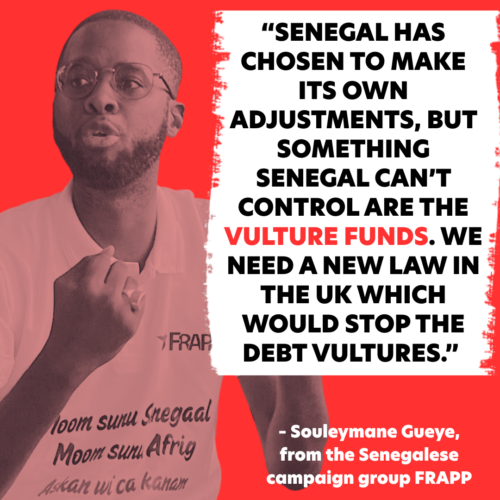
Souleymane Gueye, from the Senegalese campaign group FRAPP, describes how:
“The debt levels are so high in Senegal that the government doesn’t have the means to invest properly in education, health or social security.”
The Senegalese government has seen the devastating impacts of austerity conditions that African neighbours, such as Kenya and Ghana, have been forced to accept in return for bailouts from the International Monetary Fund (IMF). This big international financier is supposed to support countries in crisis – but the conditions attached to their loans have caused widespread unrest across the African continent in recent years.
Souleymane explains that:
“The sort of restructuring that the IMF is suggesting would involve them dictating austerity conditions. We don’t want the IMF giving us conditions. It’s down to us to decide how to meet our obligations, how to change the level of the debt.”
Instead, the Senegalese government has introduced its own measures to reduce public spending and increase revenue – such as taxes on alcohol and tobacco – while avoiding price hikes on essential goods like rice, oil or electricity.
But in a country where 50% of the population can’t read or write [3] and many people have no access to healthcare, these interventions are tinkering at the edges, when what the country needs is wide-scale debt cancellation, not the further draining of resources.
So why isn’t the Senegalese government trying to renegotiate with its lenders?
Countries in debt crisis around the world have looked on as the Common Framework, a process set up by the G20 group of nations in the wake of the pandemic to support countries in crisis, has led to lengthy talks and delivered little – if anything – in the way of debt relief.
Instead of being able to get debt cancelled, countries in crisis are being pursued through the courts right here in the UK. Ethiopia is being sued right now by its’ private lenders, after they refused to agree even the limited debt relief due under the Common Framework.
The climate of fear that this has created means that countries like Senegal are unwilling to risk seeking debt relief from their lenders. They keep paying their massive unjust debts even though they’re in a crisis – because they fear being pursued through the courts by greedy banks and hedge funds.
As Souleymane outlines:
“Senegal has refused an IMF restructure, so it’s really at risk of being targeted by vulture funds right now. Everyone is saying to us now – if you refuse to restructure, you’re going to turn out like Argentina and NML Capital.”
(NML Capital is a subsidiary of Elliot Management, a vulture fund which successfully sued Argentina in 2001, securing billions in profit.)
Vulture funds brought cases against the Argentinian government after the country defaulted in the early 2000s, and secured eye-watering windfalls. Elliott Management and Aurelius pursued Argentina in the courts for a decade after refusing to take part in debt relief agreed by other creditors. In 2019, Elliott Management was paid $2.4bn by the Argentinian government for debt they bought for $117 million – that’s a profit of over 2000%. Aurelius’ case continues to this day.
Senegal’s debts to private lenders are overseen by UK law – as are 90% of the debts between private lenders and lower-income countries. If the threat of being sued by lenders in the UK was removed, countries like Senegal would be able to renegotiate their debts without the fear of legal action.
“So right now, this debt justice law would really, really help Senegal. It would allow Senegal to go to its lenders and renegotiate; it would allow us to breathe a bit.”
Souleymane Gueye, FRAPP
Sources
[1] Christian Aid, Between Life and debt, https://www.christianaid.org.uk/sites/default/files/2025-01/j474500-between_life_and_debt_online.pdf
[2] Calculated by Debt Justice from World Bank International Debt Statistics database and IMF World Economic Outlook database.
[3] World Bank, Senegal, https://data.worldbank.org/indicator/SE.ADT.LITR.ZS?locations=SN