Education spending has fallen by 8% in countries facing the highest risk of debt distress since 2019, according to new research by Debt Justice, as lower-income countries in debt crisis face brutal cuts in spending on healthcare and education.
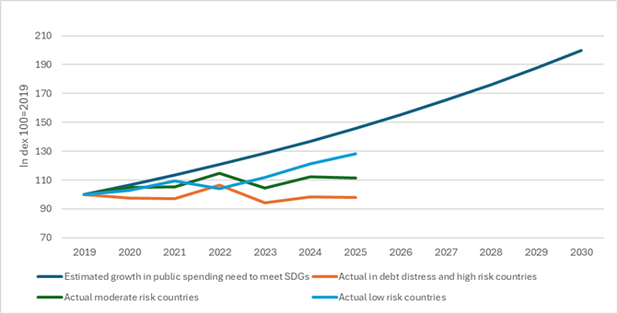
The cuts mean that governments are spending 50% less than the level needed to meet the Sustainable Development Goals by 2030.[1]
The figures are being released ahead of the IMF and World Bank Annual Meetings in Bangkok from 12 to 18 October, where the UK government is expected to announce plans for its G20 presidency in 2027.
Heidi Chow, Executive Director of Debt Justice, said:
“High levels of debt are having a devastating impact on people’s access to healthcare and education. We urgently need debt cancellation – especially from the highest interest lenders like banks, hedge funds and oil traders. The UK government must use its presidency of the G20 next year to seek agreement on a fast, effective and fair debt cancellation scheme.”
Catherine Mithia from the African Forum and Network on Debt and Development (Afrodad), said:
“This research confirms the human cost of debt. Governments in high-debt countries are being forced to cut education and health spending, because the world lacks adequate mechanisms for timely, coordinated and equitable debt restructuring for low- and middle-income countries. During its G20 presidency in 2027, the UK has a chance to lead reforms of the G20 Common Framework to allow debt suspension during negotiations and to pass legislation in the UK that limits private creditors seeking recoveries through UK courts during restructuring.”
Souleymane Gueye, from the Senegalese campaign group FRAPP, said:
“In Senegal, half of our revenue goes to creditors. Education and healthcare share barely a quarter. This is no longer a budget; it is a ransom.”
The research finds that in lower-income countries the IMF classifies as in debt distress or at high risk of being so, education spending has been cut by on average 8%, and health spending by 1%, since 2019. Overall public spending has been cut by 2%. Spending in lower-debt burden countries has increased, but at a far slower rate than is likely to be needed to meet the Sustainable Development Goals.
Graph. Growth needed in public spending needed to meet the Sustainable Development Goals, contrasted with actual growth in spending by debt risk category
External debt burdens have increased in recent years due to the Covid crisis, the global rise in interest rates, climate disasters and now the rise in energy and essential import costs due to the closure of the Strait of Hormuz. Kristalina Georgieva, Managing Director of the IMF, has said the current rise in global interest rates is worsening the debt problem in lower income countries.[2]
In 2020 the G20 created a debt relief scheme, the Common Framework for Debt Treatments. In September 2026 Senegal became just the fifth country to apply for debt relief through the scheme.
The other four countries have all suffered from slow and inadequate relief, with private creditors a major obstacle. Chad received no debt relief after its main private creditor, Glencore, refused to negotiate. Ethiopia was pressured into paying more when vulture funds began the process of suing the East African country in the UK High Court.[3]
African governments have said the G20 Framework “has not provided a pathway towards the quick restoration of debt sustainability, creating some considerable scepticism as to its potential to deliver effectively for highly indebted countries, particularly in Africa”.[4]
In Kenya, real government spending per person on education has been cut by 9% since 2019, and health spending by 26%. Kenya is rated as at high risk of debt distress by the IMF. External debt payments are over 20% of government revenue. Of Kenya’s external debt payments, 47% are to private lenders, 30% to other governments and 23% to multilateral institutions.[5]
Senegal faces a similar problem. Of Senegal’s external debt payments in 2026, 62% are to private lenders, 25% to multilateral institutions and 12% to other governments.[6]
Notes
[1] Debt Justice’s briefing ‘How external debt burdens are helping drive cuts in spending on healthcare and education’ is available at https://debtjustice.org.uk/wp-content/uploads/2026/09/Health-and-education-spending_10.26.pdf
All the calculations in this research are publicly available at https://debtjustice.org.uk/wp-content/uploads/2026/09/Public-spending_09.26.xlsx
[3] Save the Children and Debt Justice’s report ‘Now is The Time to Act: Six Reforms for the G20 Common Framework for Debt Treatments’ is available at https://resourcecentre.savethechildren.net/document/now-is-the-time-to-act-six-reforms-for-the-g20-common-framework-for-debt-treatments
[4] The Common African Position on Debt was agreed by the African Union in February 2026 https://au.int/sites/default/files/decisions/46189-EX_CL_Decisions_E.pdf
It is available at: https://afrodad.org/afcodd6/wp-content/uploads/2026/08/Common-African-Position-CAP-On-Debt.pdf
[6] Calculated from World Bank International Debt Statistics database.